 English
  French
  German
  Italian
  Spanish
  Portuguese
  Japanese
  Korean
  Chinese
  Arabic
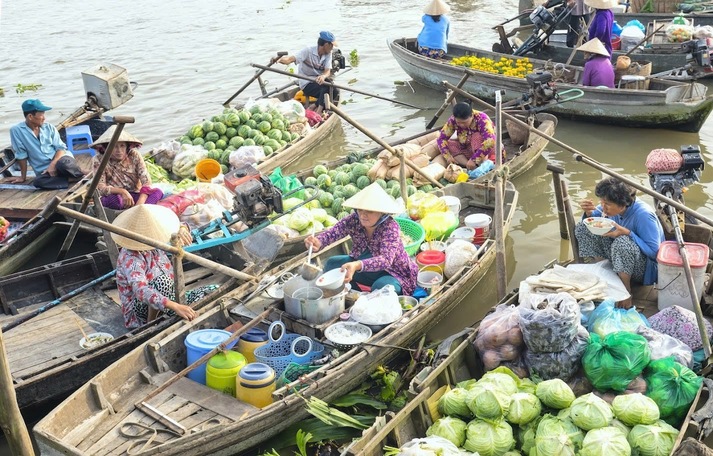
Food is one of the most meaningful ways to understand a destination. In the Mekong Delta, cuisine reflects the region’s rivers, fertile landscapes, and diverse local communities — Kinh, Khmer, and Hoa (Chinese) alike. For international travel partners, culinary experiences offer a practical way to build more authentic, differentiated Vietnam itineraries, where travellers connect with local culture through flavour, not just sightseeing.
With an abundance of freshwater fish, seafood, vegetables, and tropical produce, Mekong Delta cuisine mirrors the lifestyle of communities living along the waterways. Pairing food experiences with river journeys, floating markets, and village visits helps travellers discover a deeper, more personal side of Southern Vietnam — and gives partners a stronger story to sell.
Below, we go beyond a simple dish list. For each of the signature experiences, we look at where the dish comes from, what makes it distinctive, and how it can be positioned inside itinerary.
Five Culinary Experiences to Build Into Mekong Delta Itineraries
1. Banh Xeo — A Hands-on Local Dining Experience
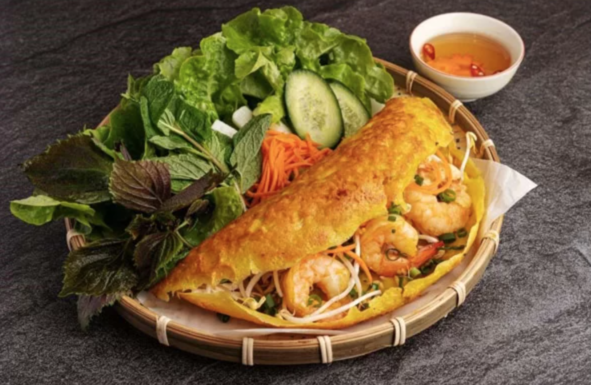
Banh Xeo (“sizzling cake,” named for the sound the batter makes hitting a hot pan) is one of Southern Vietnam’s most recognisable dishes, but the Mekong Delta version — sometimes called Banh Xeo Mien Tay — stands apart from its central Vietnam cousin. Where the Hue-style crepe is compact and lightly filled, the delta version can measure 30 to 35 centimetres across, with some roadside vendors in Can Tho and Vinh Long using pans closer to 40 centimetres. The batter is built from rice flour thinned with coconut milk and water and tinted yellow with turmeric, giving the crepe a richer, slightly sweet shell that stays crisp at the edges and tender in the fold.
The dish’s exact origin is debated. Some food historians trace it to Central Vietnam and possible French crêpe influence in the 19th century, while others point to the Mekong Delta itself, where rice and coconut were always close at hand. Regionally, fillings also shift with geography: in delta towns such as Ben Tre and My Tho, cooks sometimes substitute duck for pork and add cu hu dua, the inner heart of a coconut tree that can only be harvested once in the tree’s lifetime.
What makes Banh Xeo valuable for a group programme isn’t just the taste — it’s the ritual. Travellers tear off pieces of the crispy pancake, wrap them with fresh herbs and lettuce, and dip the parcel into fish sauce, turning a single dish into an interactive, shareable moment. For partners building family or small-group itineraries, Banh Xeo works as a low-lift, high-engagement activity that requires no special venue — a home-style eatery or a village kitchen stop is enough to deliver the experience.

2. Lau Mam — A Taste of River Life
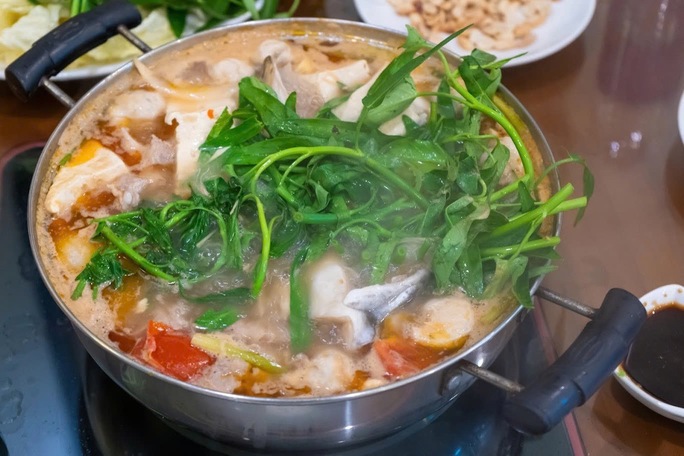
Lau mam (fermented fish hotpot) is arguably the dish that best explains how the Mekong Delta eats. It is built on mam — fermented fish paste that gives the broth a deep, pungent, intensely savoury quality that takes some getting used to — usually made from mam ca linh or mam ca sac, fermented fish varieties native to the delta’s waterways. The broth itself is layered: fish sauce and coconut water form the base, enriched with sautéed pork belly, garlic, lemongrass, and chili.
Regionally, the dish is closely associated with An Giang and Can Tho provinces; Chau Doc in An Giang is considered its spiritual home, though strong versions are also found in Can Tho. What distinguishes a delta-grown pot from a lau mam served elsewhere in Vietnam is the produce: locally fermented fish paste alongside seasonal water vegetables such as bong dien dien (sesbania flowers) and rau muong (water spinach), many of which are hard to source outside the region. A full spread typically includes an extensive mix of proteins and greens — fresh fish, crab meat, snails, eel, pork, and shrimp, served alongside eggplant, bitter melon, water dropwort, dien dien flowers, water lily, and straw mushrooms — which is why the dish is often marketed locally as ideal for vegetable lovers as much as for seafood fans.
Because lau mam is a shared hotpot cooked at the table, it naturally suits group travel and MICE-style programmes: guests cook and serve themselves, conversation flows, and the format photographs well for content-hungry clients. It also gives guides a natural entry point to talk about the delta’s fermentation traditions and river-based food economy — useful material for culturally curious travellers.
3. Hu Tieu My Tho — A Local Taste of Everyday Life
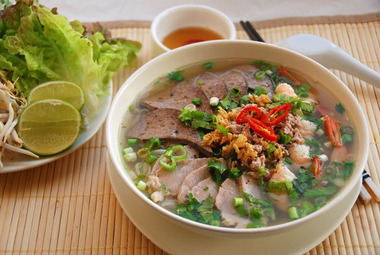
Hu Tieu My Tho is the Mekong Delta’s answer to pho: a noodle soup eaten for breakfast, associated with a single town, and instantly recognisable by its noodle rather than its broth. The dish’s roots are Chinese — it originally derives from Chinese culinary traditions and was introduced in My Tho during the 1960s by Chinese immigrants who opened small roadside stalls — but it has since become fully localised as a symbol of Tien Giang province.
The defining feature is the noodle itself, made from the Go Cat rice variety, a local specialty grown in My Phong Commune, which produces a firmer, more translucent, chewier noodle than the softer rice noodles found elsewhere in the south. Locally, the dish is sometimes nicknamed “chewy Hu Tieu” or “Hu Tieu Dai” for this exact texture. The broth is simmered from pork bones for a clear, sweet base, and the bowl is finished with a mix of toppings — commonly pork, pork heart, shrimp, minced pork, quail egg, and crab meat — along with chopped fried garlic, which gives the dish its distinctive aroma.
Because hu tieu is an everyday breakfast dish rather than a special-occasion meal, it is one of the easiest culinary stops to build into a morning itinerary — travellers get to sit where locals actually eat, without disrupting the day’s schedule. For partners assembling day-trip or overnight My Tho programmes, a hu tieu breakfast stop adds authenticity at minimal cost or logistics.
4. Elephant Ear Fish — A Traditional Mekong Meal
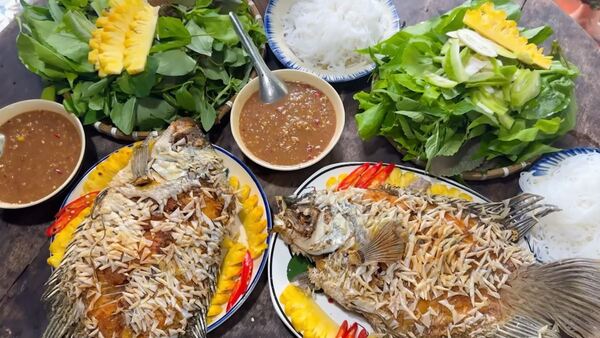
Ca Tai Tuong Chien Xu (deep-fried elephant ear fish) is one of the most visually striking dishes travellers will encounter in the delta, and one of the easiest to sell on photographs alone. The fish is a type of giant gourami, a freshwater species weighing roughly 0.5 to 1.5 kilograms that is farmed in ponds and swamps across the delta, named for its broad, ear-shaped body. The preparation is deliberately theatrical: the cook fries the whole fish — scales, fins and all — in a large pan of hot oil without removing the skin, so the exterior turns crisp while the meat inside stays tender, and it is then served standing upright on the platter.
The eating ritual is what turns this into an experience rather than just a meal. Diners peel off pieces of the crispy fish and roll them in rice paper with pickles, cucumber, and fresh herbs, before dipping the parcel into a sauce made from minced garlic, fish sauce, tamarind, sugar, lemongrass, and chili. Some cooks finish the dish with roasted crushed peanuts for extra texture, and a few delta restaurants offer an alternative dip using mam nem, a fermented fish sauce with a sharper, more pungent character.
Because the fish is large and meant for a table rather than an individual portion, it’s naturally suited to group lunches — a single fish can anchor a shared meal for four to six guests, making it a strong centrepiece for riverside restaurant stops built into cruise or boat-tour itineraries.
5. Bun Nuoc Leo Soc Trang – A Cultural Food Journey
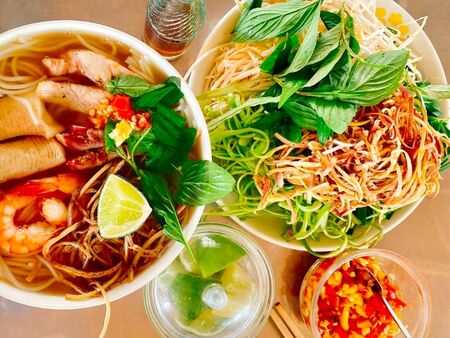
Bun Nuoc Leo is arguably the dish that tells the deepest cultural story in the Mekong Delta, because its recipe itself is a record of migration. The dish originated with the Khmer community and remains deeply influenced by the culinary traditions of the Khmer, Kinh, and Chinese communities living side by side in Soc Trang province. Locally, it is described as a dish of solidarity: the Khmer contributed the fermented fish paste and herbal broth base, the Kinh added the rice noodles and fish toppings, and the Chinese community brought roast pork into the bowl — a fusion that reflects the diversity and unity of the region’s communities.
The broth — nuoc leo — is the heart of the dish. It is built from fish sauce made from ca sac (snakeskin gourami) or ca linh (Siamese mud carp), combined with bo hoc, a fermented fish paste known as prahok in Khmer, along with ngai bun (a turmeric-like root) and lemongrass to balance the fishy notes. A finished bowl typically includes boiled snakehead fish, shrimp with skin and bones removed, and thinly sliced roast pork, served with fresh water morning glory, shredded banana flower, chives, and bean sprouts. In 2023, the dish gained wider recognition when it was recorded as an Asian Record dish for its distinctive blend of flavours.
For itinerary planners, Bun Nuoc Leo is a strong tool for storytelling: it lets a guide connect a single bowl of soup to the region’s Khmer heritage, its temple festivals, and its multicultural identity — material that resonates strongly with culturally motivated travellers and can be woven into Soc Trang or Tra Vinh cultural-route itineraries.
xr:d:DAFKC2uuMvo:234,j:36204710459,t:22092414
Creating More Authentic Mekong Delta Itineraries
None of these five dishes need to stand alone. Combined thoughtfully, they form a natural food route through the delta’s core provinces — a hands-on Banh Xeo stop near Can Tho, a shared Lau Mam dinner in Chau Doc or An Giang, a My Tho breakfast of Hu Tieu before a river cruise, a riverside Elephant Ear Fish lunch, and a Bun Nuoc Leo cultural stop in Soc Trang. Sequenced this way, food experiences do more than fill a meal slot on a program — they give partners a differentiated narrative arc for the whole trip, moving guests from casual street food to communal dining to a cultural deep-dive.
Combining these food experiences with river cruises, floating markets, and village activities allows partners to build balanced itineraries that showcase both the natural and cultural values of Southern Vietnam, while giving clients something more memorable to sell than a standard sightseeing route.
As a Vietnam-based Destination Management Company, An Vui Travel supports international partners in designing meaningful, ground-level Vietnam itineraries. With local destination knowledge and operational experience across the Mekong Delta, our team assists partners with itinerary planning, transportation coordination, and the sourcing of authentic dining experiences — from a family-run Banh Xeo kitchen to a riverside Lau Mam dinner. From culinary journeys to cultural exploration, An Vui helps design smooth, well-paced programmes that match different traveller expectations and group sizes.
Interested in creating authentic Vietnam experiences for your clients? Connect with An Vui Travel to explore tailored itinerary solutions.
🔗 Let’s connect and grow together!
Headquarters / Sales Hub: 5th Floor, H&N Building, 329, 331 Hoang Quoc Viet Street, Cau Giay District, Hanoi, Vietnam.
Operation Offices: Vietnam (Hanoi, Danang, Ho Chi Minh), Laos (Vientiane), Cambodia (Siem Reap), Myanmar (Yangon), Thailand (Bangkok).
#AnVuiTravel #MekongDelta