 Portuguese
  English
  French
  German
  Italian
  Spanish
  Japanese
  Korean
  Chinese
  Arabic
Just 7 kilometers from the busy streets of Hue city, Thuy Bieu Village offers something increasingly rare on a standard Vietnam itinerary: a place that hasn’t been reshaped to perform for tourists. What makes it remarkable isn’t any single attraction, but the way visitors are dropped into the actual rhythm of village life rather than a version staged around them.
This matters because modern travelers, especially international ones, are shifting away from fixed itineraries toward slower, more immersive travel. For travel agents, that’s the key to selling Thuy Bieu well: the immersion here isn’t manufactured for the tour, it’s the real, everyday life of the village, which is exactly what today’s travel trend is built around.
History of Thuy Bieu Village
The village was formed from the merger of two older settlements, Nguyet Bieu and Luong Quan. Its name, meaning water gourd, comes from the distinctive shape of the land, which is bordered on three sides by water where the Perfume River bends around it. That river geography shaped the village for centuries, feeding the fruit orchards the area is now known for and keeping it slightly apart from the growth of central Hue, both physically and culturally.
The village does sit near two notable relics of the Nguyen Dynasty, Ho Quyen, a tiger arena once used for ceremonial fights staged for the royal court, and the nearby Voi Re, officially Long Chau Temple, built to honor the dynasty’s war elephants. These give Thuy Bieu a layer of imperial history that pairs naturally with a Hue Citadel tour. But unlike the Citadel, these sites were never the center of daily life here. That role belongs to the ancient Ruong style houses, built with elaborate wooden columns and no interior partitions, which still stand today because families continue to live in them rather than because they have been preserved as exhibits. The Thanh Tra pomelo tree, closely associated with the village, blooms fragrant white flowers in spring and fruits by summer, and that seasonal cycle still shapes what villagers grow, harvest, and sell today. History here is not something visitors observe from a distance, it is something the village is still actively living out.
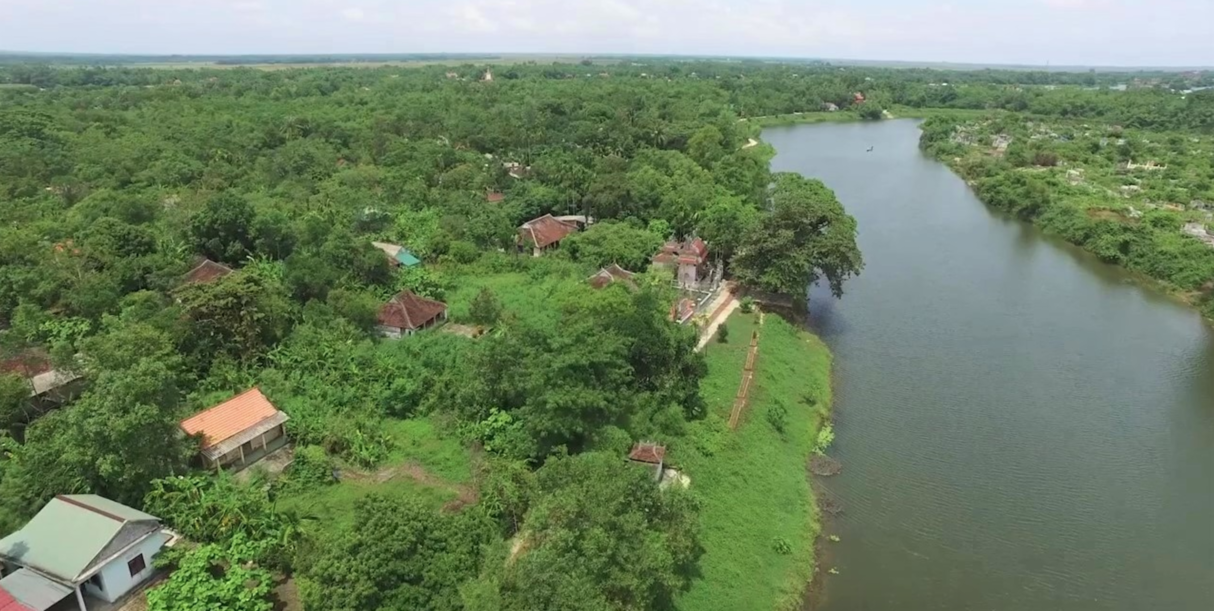
Source:
https://en.fareastour.com/destination/detail/thuy-bieu-100-years-old-village-in-central-hue-46.html
Why should travel partners prioritize selling the Thuy Bieu Village tour?
For agents and operators, Thuy Bieu’s value comes directly from how genuinely local the experience is, and that translates into several concrete advantages.
It gives deep local experiences for visitors. Many clients say they want an authentic experience, but few Hue products can actually back that up. Because Thuy Bieu’s communal house, garden homes, and crafts are functioning parts of the village rather than attractions built for visitors, agents can market the word authentic here without overselling it.
It creates natural upsell opportunities. Cooking classes, craft workshops, and herbal foot soaks work because they are extensions of real village livelihoods rather than manufactured add ons, which makes them feel earned rather than transactional and easier for clients to justify paying more for.
It is easy to combine. The village sits close to Thien Mu Pagoda and other central Hue sites, so it slots naturally into an existing itinerary as a half day or full day addition rather than requiring a separate overnight stay.
It is a genuine point of difference. Many operators sell the same handful of Hue monuments. A tour built around Thuy Bieu lets partners offer clients a slower, which is exactly the kind of contrast that makes a Hue itinerary feel complete rather than repetitive.
Key Activities in Thuy Bieu Village
Cycling through the Thanh Tra gardens. Guests pedal along shaded lanes lined with pomelo trees still tended by the families who own them, a relaxed way to enter the village on its own terms before the day’s activities begin.
Ho Quyen and Voi Re. A stop at the old royal arena and the elephant temple gives the tour a historical anchor and connects the village to the wider imperial story of Hue.
Ancient garden houses. Several centuries old Ruong houses are open to visitors, and because they remain occupied homes, guests see traditional Hue architecture and wood carving in daily use, not behind rope barriers.
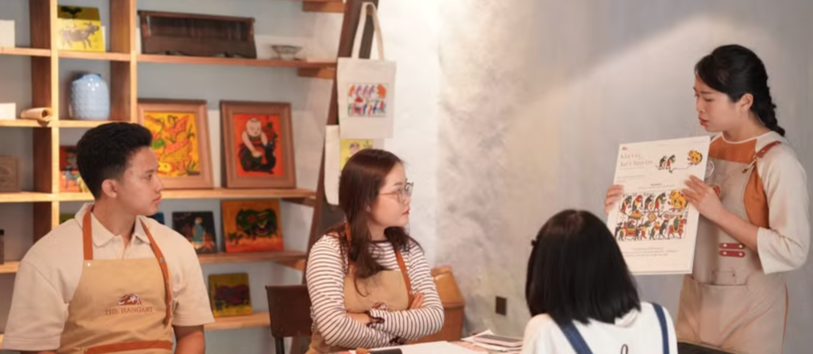
Traditional craft experiences. Incense making and silk painting sessions let guests engage directly with village livelihoods that exist alongside farming, learning from people for whom these are working skills, not performances.
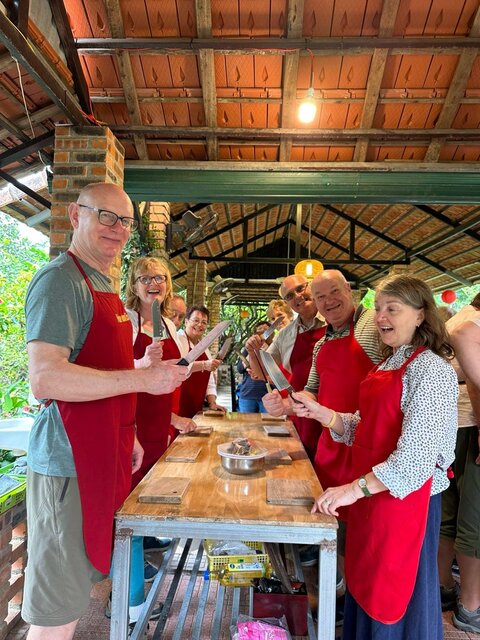
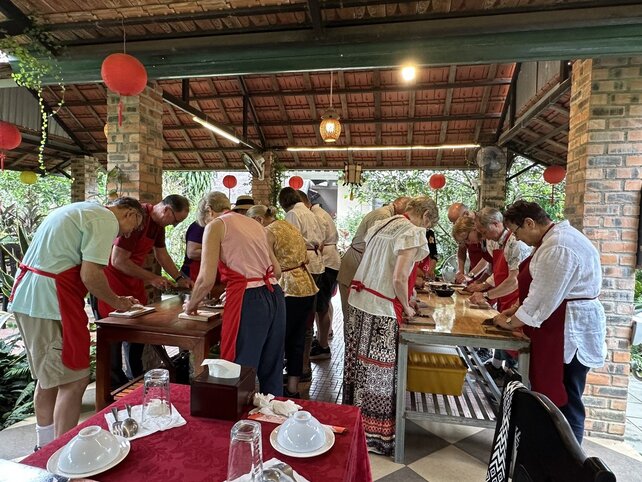
Cooking and tasting. Depending on the itinerary, guests can help prepare Thanh Tra jam or Hue style spring rolls, then eat a home cooked lunch made from locally sourced ingredients inside one of the village’s garden houses, often prepared by the women of that household.
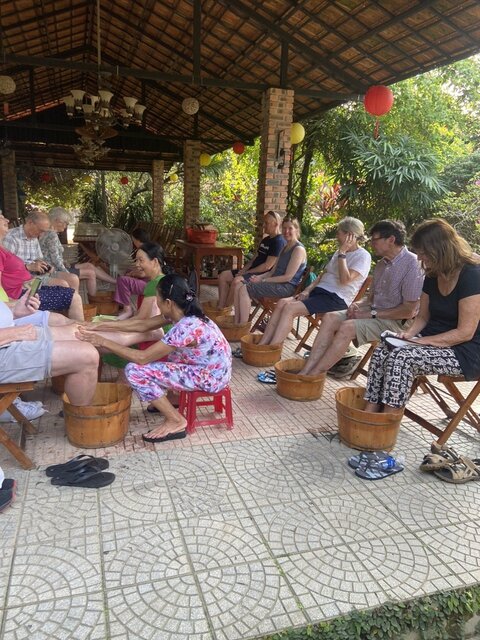
Herbal foot bath. A relaxing close to the day and a small but memorable local touch that clients often mention in reviews.
Thanh Tra fruit tasting. In season, the fruit is sold throughout the village straight from the growers, making an easy, affordable gift item with a direct link back to what guests just walked through.
Sources:
https://www.originvietnam.com/destinations/thuy-bieu-village/
https://vietnamtour.com/tips/destinations/hue/attractions/thuy-bieu-ancient-village-in-hue.html
https://joytime.vn/en/product/2346-day-tour-explore-thuy-bieu-ancient-village-and-join-a-cooking-class-hue.html%20srsltid=AfmBOoroRbykXQD-H8Mml7UJ9QLQJgMT7pfQqh-178GzZCQCSWvFb-xu
What makes Thuy Bieu Village remarkable is not any one stop on this list, it is that every stop is real. For travel partners, that is the whole pitch. Clients are not paying to see a village performed, they are paying to spend a few hours inside one that is still quietly going about its own life. This is an ideal time for travel agents to capitalize on unique of Thuy Bieu Village and expand demand of travellers.
🔗 Let’s connect and grow together! Visit us at
Headquarter / Sales Hub: 5th Floor, H&N Building, 329-331 Hoang Quoc Viet Street, Cau Giay District, Hanoi, Vietnam.
Escritórios de operações: Vietnam (Hanoi, Danang, Ho Chi Minh), Laos (Vientiane), Cambodia (Siem Reap), Myanmar (Yangon), Thailand (Bangkok)
Email: info@anvuitravel.com
Cellphone No. (Hotline): +84 912 683 908 (Whatsapp, Telegram, Viber)
Fanpage: https://www.facebook.com/anvuitravel84/
Tiktok: https://www.tiktok.com/@anvuitravel
Instagram: https://www.instagram.com/anvuitravel/
Linkin: https://www.linkedin.com/company/anvui-travel/about/?viewAsMember=true
Web: https://anvuitravel.com
✨ Together, let’s make travel extraordinary! ✈️
#ThuyBieuVillgage #HueCity #AnVuiTravel #LocalExperience