 Japanese
  English
  French
  German
  Italian
  Spanish
  Portuguese
  Korean
  Chinese
  Arabic
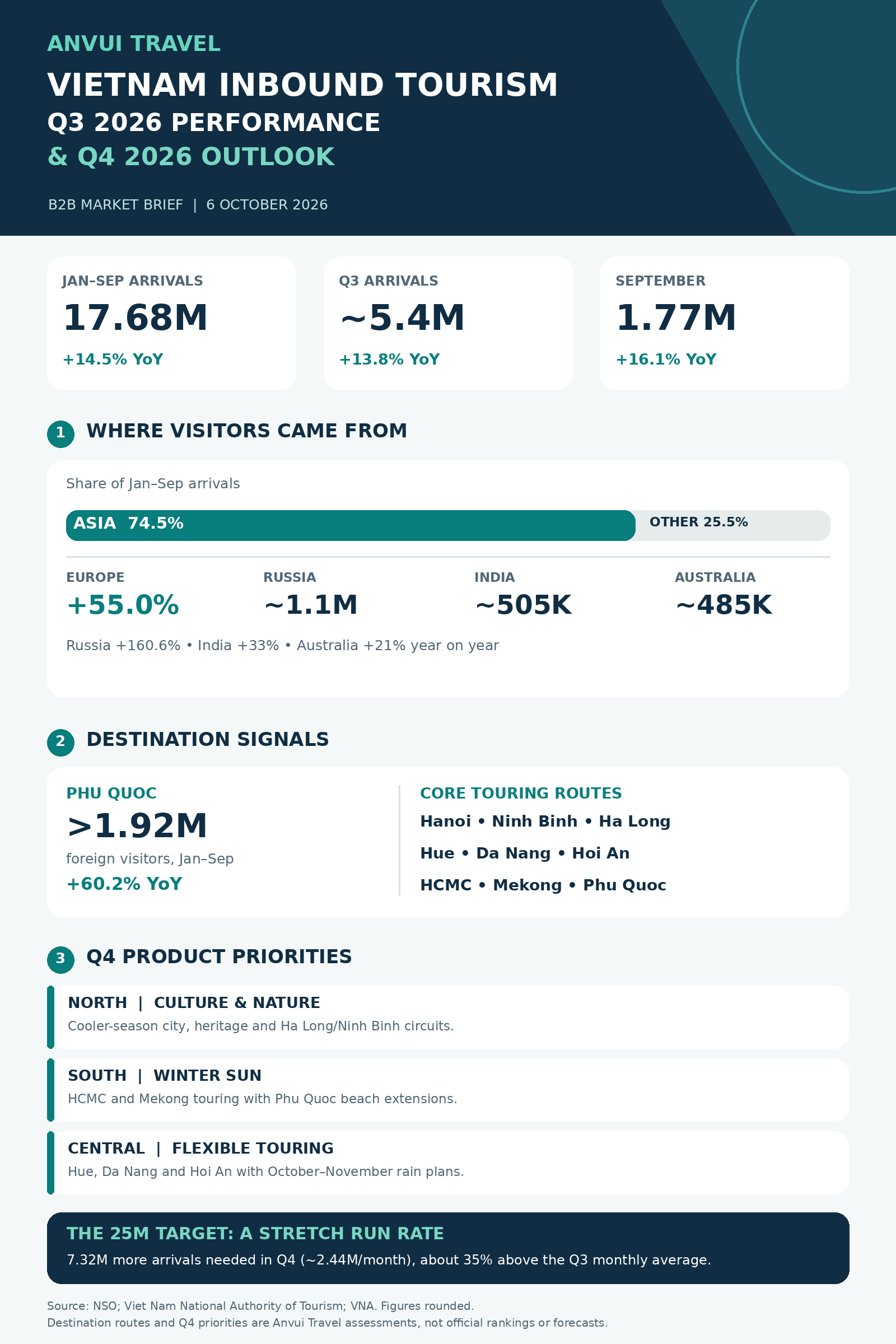
Vietnam welcomed 1.77 million international visitors in September 2026, down 11.3% from August but up 16.1% year on year. Strong European growth, Russia’s rapid expansion and continued momentum across several ASEAN markets point to a more diversified inbound landscape as Vietnam enters the final quarter of the year.
For international travel partners, the September figures provide more than a measure of visitor volume. They offer useful signals about where demand is strengthening, which source markets may require closer attention and where new product opportunities could emerge for Q4 2026 and early 2027.
1. September 2026 at a Glance
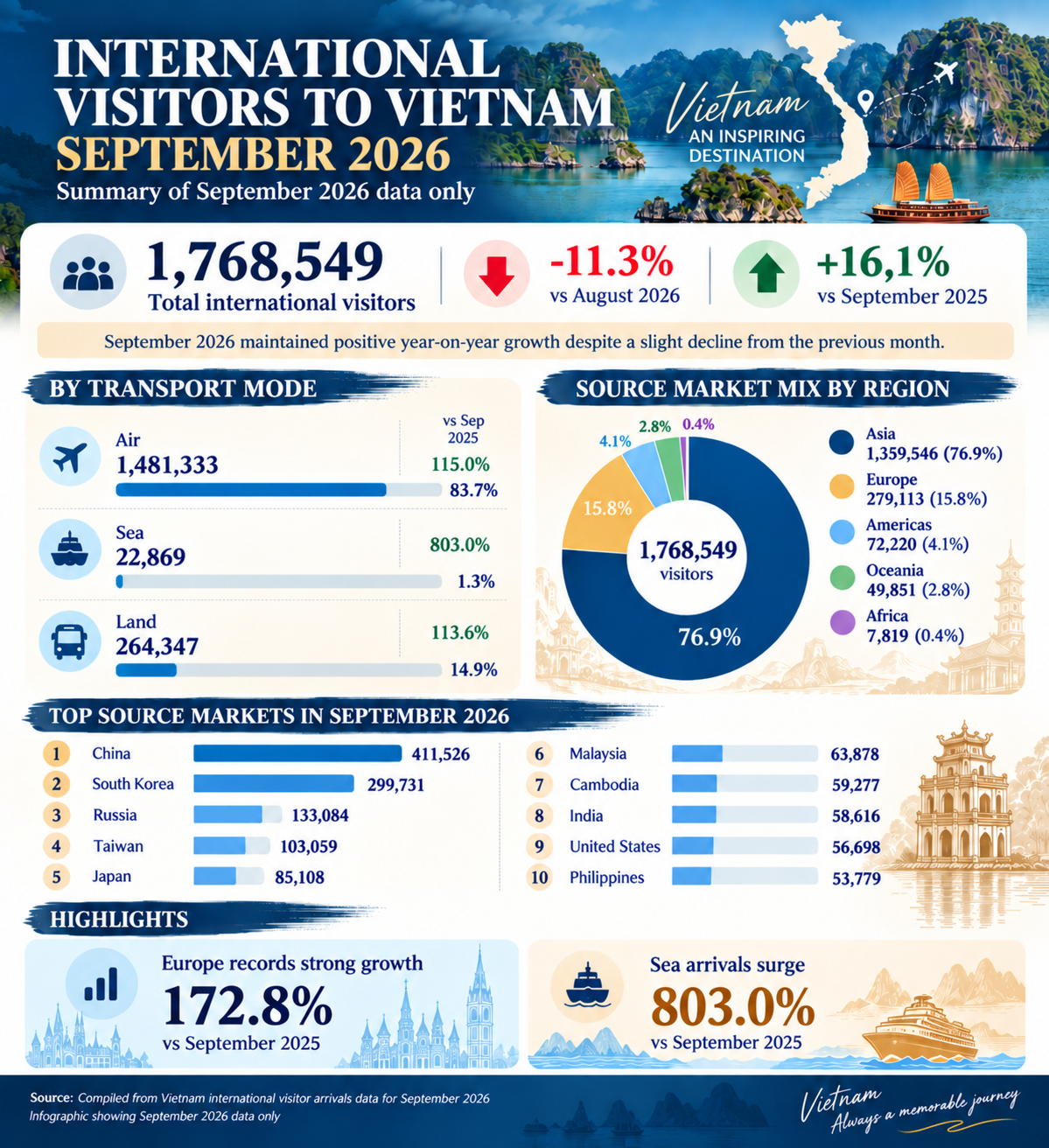
Vietnam received 1,768,549 international visitors in September 2026, according to official tourism statistics. The monthly total was 11.3% lower than August 2026, when the country welcomed almost 2 million international visitors, but remained 16.1% higher than September 2025.
Asia continued to dominate inbound volume with 1,359,546 visitors, followed by Europe with 279,113, the Americas with 72,220, Oceania with 49,851 and Africa with 7,819. The month on month decline therefore needs to be viewed in context. August delivered particularly strong inbound volume, while September remained substantially ahead of the same month in 2025.
For international travel partners, the more relevant signal is that Vietnam entered Q4 with international demand continuing to expand year on year while growth was becoming increasingly diversified across several regional and long haul markets.
2. Asia Remains the Foundation of Vietnam’s Inbound Market
Asia generated approximately 1.36 million arrivals in September, maintaining its position as Vietnam’s most important source region by volume.
China remained the largest individual source market, contributing 411,526 visitors. Although arrivals were 10% lower than August, they were 13.8% higher than September 2025.
South Korea ranked second with 299,731 visitors, but followed a different trajectory. Arrivals were 19.4% lower than August and 8.8% below September 2025.
For travel partners, this difference matters. China and South Korea remain major volume markets for Vietnam, but the September figures show why they should not automatically be treated as one Northeast Asian demand trend. Product planning, pricing and market strategies need to reflect different performance patterns by source market.
Other Northeast Asian markets delivered stronger year on year results. Taiwan reached 103,059 visitors, up 18.2%, while Japan contributed 85,108, an increase of 9.0%. Several Southeast Asian markets also expanded compared with September 2025. Cambodia increased 31.0%, the Philippines 30.0%, Singapore 16.1%, Indonesia 15.4%, Malaysia 4.4% and Thailand 4.3%. Malaysia was particularly notable on a monthly basis, with September arrivals increasing 41.3% from August, while Indonesia grew 8.4%. India recorded 58,616 visitors. September volume was close to August but 4.5% below September 2025. The result highlights another important consideration for partners: monthly performance should be separated from the longer term development of a source market when making product or contracting decisions.
From a B2B perspective, Asia continues to provide Vietnam with scale, but the increasing contribution of different ASEAN and Northeast Asian markets creates opportunities for greater portfolio diversification rather than reliance on only one or two major source markets.
3. Europe Emerges as a Major Growth Signal
Europe was one of the most significant features of Vietnam’s September inbound performance. Vietnam welcomed 279,113 European visitors, representing a 72.8% increase compared with September 2025, despite arrivals being 15.3% lower than August.
The standout market was Russia. Russia generated 133,084 visitors in September, making it Vietnam’s third largest individual source market during the month after China and South Korea. Arrivals were only 3.1% below August while increasing 127.5% year on year.
Other important European markets also recorded positive year on year growth. Germany increased 26.7%, France 16.4%, the United Kingdom 8.1%, Italy 54.5% and Spain 33.1%.
For international travel partners, this is commercially relevant because the growth is spread across several European source markets rather than being limited to one country. The figures strengthen the case for maintaining Vietnam in long haul winter portfolios and developing programmes that can accommodate different European traveller profiles.
For Russia, Vietnam’s warm weather resort destinations create opportunities for beach focused holidays and beach plus culture combinations. For Western European markets, partners can continue developing longer itineraries combining cultural touring, local experiences, nature, gastronomy and slower forms of travel.
The key opportunity is therefore not simply higher European visitor volume. It is the ability to build a broader range of Vietnam products around different market motivations and travel periods.
4. Long Haul Markets Remain Positive
The United States contributed 56,698 visitors in September, making it the largest source market from the Americas. Although US arrivals fell 21.7% compared with August, they remained 13.9% higher than September 2025. Canada recorded 9,486 visitors, also lower than August but 5.8% higher year on year. Oceania remained comparatively stable. Australia generated 43,943 visitors, just 1.7% below August and 1.6% above September 2025. New Zealand contributed 5,729 visitors, representing an 8.4% year on year increase.
The performance of these markets is important for international tour operators because long haul visitors can support a different type of Vietnam product from short regional trips. Longer stays can create room for multi destination itineraries, extensions into secondary destinations, experiential activities and combinations connecting Vietnam with neighbouring Southeast Asian countries. The September figures do not suggest uniform growth across every long haul market, but they show that demand remained above the previous year in several commercially important source countries.
5. Air Remains Dominant While Sea Arrivals Show New Potential
Air travel remained the primary gateway to Vietnam, accounting for 1,481,333 international arrivals in September. Air arrivals declined 12.9% month on month, explaining much of the overall decrease from August, but remained 15.0% above September 2025. Land arrivals reached 264,347, decreasing 6.8% from August while growing 13.6% year on year. The most striking percentage movement came from sea travel. Vietnam recorded 22,869 international arrivals by sea, equivalent to 237.5% of August’s level and 803% of the September 2025 level. This represents growth of approximately 137.5% month on month and 703% year on year.
The percentage increase is exceptional, but scale remains important. Sea arrivals still represented only a small proportion of Vietnam’s total international arrivals during the month.
For the travel trade, the more useful interpretation is that cruise related tourism deserves closer attention as a specialised product opportunity rather than as a replacement for Vietnam’s core air arrival market. Growth in cruise traffic can create demand for reliable ground handling, private shore excursions, compact cultural programmes, culinary experiences and destination services designed around fixed port schedules.
6. Commercial Signals for International Travel Partners
September’s figures reveal several signals that can help international partners plan Vietnam programmes for Q4 2026 and 2027.
Asia continues to deliver the scale. China and South Korea remain two of Vietnam’s most important source markets, but September demonstrates the need to monitor them separately. At the same time, stronger results from markets such as Taiwan, Japan, Cambodia, the Philippines, Singapore and Indonesia give Vietnam a broader regional demand base. For partners working with Asian markets, this creates opportunities to develop more differentiated programmes rather than relying exclusively on standard first time Vietnam circuits.
Europe is becoming increasingly important to Vietnam’s inbound mix. A 72.8% year on year increase in European arrivals is one of September’s strongest commercial signals. Russia accounts for a significant part of that growth, but Germany, France, the United Kingdom, Italy and Spain also remained above September 2025 levels. For overseas partners, this supports continued development of Vietnam as a winter long haul destination with room for beach holidays, cultural touring, nature based products and experience focused itineraries.
ASEAN growth creates opportunities for shorter and repeat travel. Markets such as the Philippines, Cambodia, Singapore and Indonesia recorded strong year on year growth. Travellers from nearby markets may not require the same products as first time long haul visitors. Shorter itineraries, city plus beach combinations, weekend extensions, food focused travel and deeper local experiences can help partners develop more targeted products for this segment.
One month should not determine contracting strategy.
September was lower than the strong August result, but remained 16.1% ahead of September 2025. This illustrates why international partners should evaluate Vietnam through several indicators including year on year growth, source market performance, seasonality, connectivity and traveller profile rather than reacting to a single monthly movement. Cruise tourism offers a smaller but emerging specialist opportunity.
The sharp rise in sea arrivals comes from a relatively small base, so it should be interpreted carefully. Nevertheless, higher cruise traffic can create additional opportunities for DMCs and overseas cruise partners that require dependable local operations, efficient transportation and experiences that can fit precisely within port call schedules.
Vietnam’s Value Is Increasingly in Its Market Diversity
The strongest message from September is not simply that Vietnam welcomed 1.77 million international visitors. It is that inbound demand is coming from an increasingly diverse mix of markets.
Asia continues to provide the majority of visitor volume. Europe is delivering some of the strongest growth. Major long haul markets remain above last year’s levels, while several ASEAN countries are expanding and cruise arrivals are creating an additional specialist segment.
For international travel partners, that diversity has commercial value. It allows Vietnam to support multiple product strategies within the same destination: short regional escapes, winter sun holidays, longer cultural journeys, beach extensions, experiential programmes, repeat visitor products and cruise based excursions.
As partners prepare their Q4 2026 and 2027 portfolios, the opportunity is therefore not simply to sell more Vietnam. It is to match the right Vietnam product with the source markets where demand is developing most strongly.
Source: https://vietnamtourism.gov.vn/statistic/international
🔗 Let’s connect and grow together!
Headquarters / Sales Hub: 5th Floor, H&N Building, 329, 331 Hoang Quoc Viet Street, Cau Giay District, Hanoi, Vietnam.
Operation Offices: Vietnam (Hanoi, Danang, Ho Chi Minh), Laos (Vientiane), Cambodia (Siem Reap), Myanmar (Yangon), Thailand (Bangkok).