 Spanish
  English
  French
  German
  Italian
  Portuguese
  Japanese
  Korean
  Chinese
  Arabic
How Is Vietnam’s Tourism Growth Reshaping Travel Behavior?
Multi-destination travel is emerging as one of the most profitable segments in Vietnam’s tourism market, driven by both strong visitor growth and shifting traveler behavior.
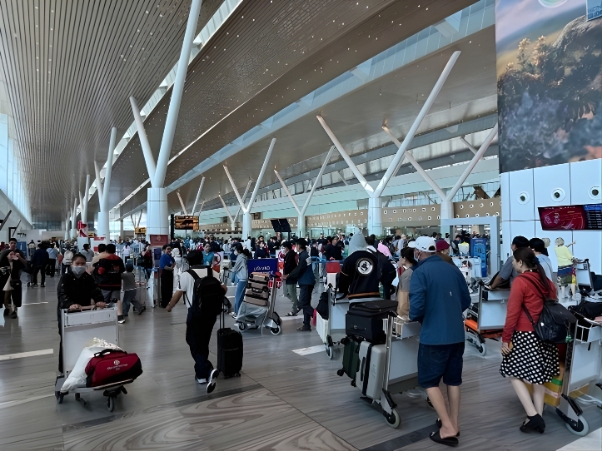
Vietnam’s tourism industry is entering a new phase of development, marked not only by increasing visitor numbers but also by significant changes in how travelers plan their journeys. In 2025, the country welcomed over 21.17 million international visitors, an increase of 20.4% year-on-year, positioning Vietnam among the fastest-growing destinations in Asia. This momentum has continued into 2026, with more than 4.6 million international arrivals recorded in the first two months, reflecting sustained demand from global markets.
Beyond the growth in arrivals, a deeper transformation is taking place. International travelers, particularly from long-haul markets such as Europe and the United States, are increasingly opting for longer and more experience-driven trips.
On average, international visitors stay approximately 7 to 9 days in Vietnam, with total trip expenditures ranging between US$900 and US$1,200, depending on travel preferences and origin markets. These indicators suggest that travelers are not only staying longer but are also spending more per trip, creating favorable conditions for multi-destination travel to expand.
Sources:
- https://vietnamnews.vn/society/1743207/viet-nam-s-international-tourism-sees-best-year-in-2025-with-arrivals-hitting-over-21-million.html
- https://vietnamtourism.gov.vn/en/statistic/international
- https://e.vnexpress.net/news/travel
Why Are Travelers Choosing Multi-Destination Journeys Over Single Stops?

As travel becomes more time- and cost-intensive, especially for long-haul markets, travelers are increasingly motivated to maximize the value of each trip. Instead of focusing on a single destination, they are choosing to combine multiple locations into a unified itinerary that offers a wider range of experiences.
This shift reflects a broader evolution in traveler expectations. Modern tourists are more experience-oriented, seeking to explore cultural heritage, natural landscapes, and leisure destinations within the same journey. The ability to integrate these elements into a single trip allows for a more complete and satisfying travel experience.
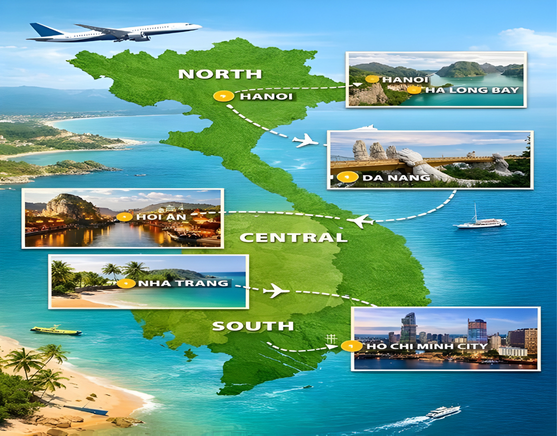
Vietnam is particularly well-suited to this trend due to its geographic diversity and relatively compact layout. Distinct regions offering different experiences can be reached within a short time frame, with domestic flights typically lasting one to two hours. This makes it feasible for travelers to move efficiently between destinations while maintaining a well-paced itinerary.
Sources:
How Does Multi-Destination Travel Increase Revenue for Partners?
From a commercial perspective, multi-destination travel provides a strong opportunity to enhance revenue per customer.
This model increases revenue through several key factors:
- Longer trip duration, leading to more nights of accommodation and extended service usage
- A broader range of services, including transportation, multi-location accommodation, and guided experiences
- Cross-selling opportunities, allowing partners to expand an initial booking into a more comprehensive journey
- Higher total booking value, as travelers consume more services throughout the trip
The extension of trip duration is another important factor. While shorter trips typically last only a few days, multi-destination itineraries often extend to one or two weeks, significantly increasing total expenditure per traveler.
Source:
- https://vietnam.travel/media-industry
- https://vietnamtimes.org.vn/vietnam-tourism-recovery-and-development-strategy-2025-2026-76119.html
What Does a Typical Multi-Destination Booking Look Like in Terms of Value?
A comparison between single-destination and multi-destination travel highlights the significant difference in commercial value.
A short trip focused on a single destination, typically lasting three to four days, may include basic accommodation and a limited number of activities, with an estimated value of US$300 to US$500 per traveler.
In contrast, a multi-destination journey lasting ten to twelve days involves multiple hotel stays, intercity transportation, and a wider range of guided experiences. The total value of such a booking can range from US$1,200 to US$1,800 per traveler, depending on the level of service and customization.
This clearly demonstrates how multi-destination travel not only enhances the overall travel experience but also significantly increases revenue per customer.
Source:
How Does Vietnam Compare to Other Southeast Asian Destinations?
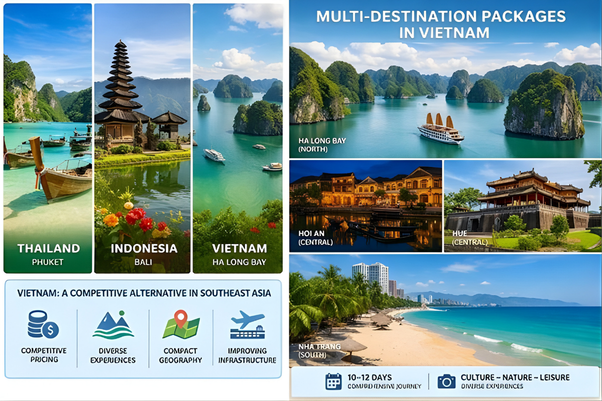
Within Southeast Asia, destinations such as Thailand and Indonesia have long established themselves as multi-destination travel hubs, supported by well-developed tourism infrastructure and established travel routes.
Vietnam, however, is rapidly strengthening its position in this segment and is increasingly seen as a competitive alternative to these more mature markets. The country offers a high level of experience diversity within a relatively compact geography, allowing travelers to combine multiple destinations more efficiently.
In addition, Vietnam remains competitively priced, enabling travelers to access a wide range of experiences at a relatively lower cost. This combination of diversity, accessibility, and value positions Vietnam as an increasingly attractive option for multi-destination travel in the region.
Source:
How Does Anvui Deliver Seamless Multi-Destination Experiences?
As a direct operator in Vietnam, Anvui supports travel partners in designing and delivering effective multi-destination itineraries.
The company leverages its local expertise to create routes that balance diverse experiences with efficient logistics, ensuring that travelers can move between destinations without unnecessary complexity or fatigue. This is particularly important in multi-destination travel, where the quality of itinerary design directly impacts the overall experience.
Anvui also provides flexible solutions tailored to different source markets, enabling partners to adapt itineraries based on traveler preferences and trip duration. With comprehensive service management and continuous operational support, the company ensures a smooth and consistent experience across all stages of the journey.
Source:
What Multi-Destination Packages Can Partners Offer Today?
Travel companies can leverage this trend by offering structured itineraries that combine multiple destinations into a single journey.
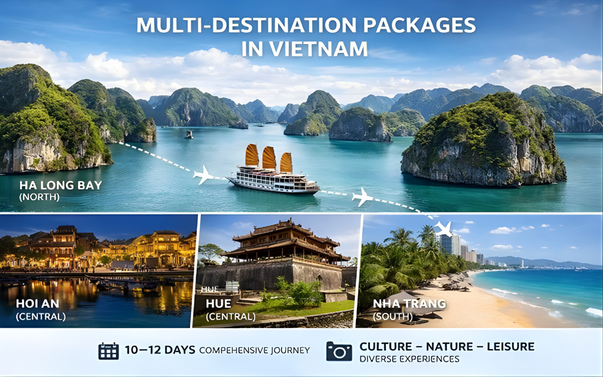
Longer itineraries, typically ranging from ten to twelve days, are well-suited for first-time international visitors seeking a comprehensive overview of Vietnam. These journeys often connect major regions, providing a balanced mix of cultural, natural, and leisure experiences.
Shorter itineraries, lasting five to seven days, are also effective for high-volume markets. These trips typically combine a major city with a nearby coastal destination, offering both exploration and relaxation within a limited timeframe.
In addition, niche itineraries focusing on nature and local experiences are becoming increasingly popular among travelers seeking more authentic and immersive journeys.
Source:
What Market Gaps Still Limit Multi-Destination Travel Growth?
Despite strong demand, multi-destination travel continues to face several challenges in execution. Planning a journey across multiple destinations requires careful coordination of transportation, accommodation, and scheduling. Without sufficient expertise, itineraries can become inefficient or overly packed.
From a partner perspective, limited local knowledge may lead to suboptimal route design, which can negatively affect both operational efficiency and the overall customer experience. This not only impacts service quality but can also reduce perceived trip value for travelers.
Source:
What Is the Future Outlook for Multi-Destination Travel in Vietnam?
Looking ahead, multi-destination travel is expected to become a central driver of Vietnam’s tourism growth. With the country targeting 25 million international visitors in the coming years, the competitive landscape is shifting toward integrated travel experiences rather than standalone destinations.
As the market continues to mature, the ability to design and deliver seamless multi-destination journeys will become a defining factor for long-term competitiveness. Travel companies that can provide well-structured and efficient itineraries will be better positioned to capture demand and differentiate themselves in an increasingly competitive market.
Source:
- https://en.vietnamplus.vn/vietnam-targets-25-million-international-visitors-for-2026-post334882.vnp
- https://vietnamtourism.gov.vn/en
How Can Partners Capture This Opportunity Today?
Travel companies that can deliver well-structured multi-destination journeys will be better positioned to capture high-value travelers and maximize revenue per booking in an increasingly competitive market.
🔗 Let’s connect and grow together! Visit us at
Headquarter / Sales Hub: Room 702, H&N Building, 329-331 Hoang Quoc Viet Street, Cau Giay District, Hanoi, Vietnam.
Oficinas de operaciones: Vietnam (Hanoi, Danang, Ho Chi Minh), Laos (Vientiane), Cambodia (Siem Reap), Myanmar (Yangon), Thailand (Bangkok)
Email: info@anvuitravel.com
Cellphone No. (Hotline): +84 912 683 908 (Whatsapp, Telegram, Viber)
Fanpage: https://www.facebook.com/anvuitravel84/
Tiktok: https://www.tiktok.com/@anvuitravel
Instagram: https://www.instagram.com/anvuitravel/
Linkin: https://www.linkedin.com/company/anvui-travel/about/?viewAsMember=true
Web: https://anvuitravel.com
✨ Together, let’s make travel extraordinary! ✈️
Hashtag: #anvuitravel #traveltovietnam #tourtovietnam #govietnam #vietnamtour